
We long for a fidelity which is a testimony not unlike that of the virgin-martyr, St. Cecilia. For love of God and conquest of the kingdom of heaven, we desire to build up the body of Christ until we ourselves are transformed into his image. (Constitutions of the Congregation)
Our Vowed Life
- St. Dominic
- St. Cecilia
 Back
Back
- St. Dominic
- Seignadou
- O Lumen
- The Habit
- St. Dominic in Our Prayers
- Fifteen Tuesdays
- Novena to St. Dominic
- Nine Ways of Prayer

Throughout our history as Dominican Sisters of St. Cecilia, we have continued to explore the mystery of our patroness, who bequeaths to us not only a sense of the beauty of worship, but also an undying virginal love for Christ even to the point of martyrdom.
Cecilia’s story is well guarded by long-standing tradition, which presents to us a young Christian girl with an undying faith in an era when faith was an unpopular and dangerous virtue. Born to pagan parents, and perhaps converted through the instrumentality of a Christian nurse, Cecilia was raised in a noble Roman home during a time of persecution. We are told that, according to custom, Cecilia’s parents arranged for her to marry a young patrician named Valerian. Cecilia, however, had already vowed her virginity to God, desiring to root herself even more deeply in her Baptismal consecration. On her wedding night, she resolutely explained her vow to Valerian, whose initial anger and confusion were transformed into conversion under the influence of his wife’s strong faith and the instruction of the Christian bishop. Valerian and Cecilia subsequently helped to convert Valerian’s brother Tiburtius, and the three became known for their works of charity and their lives of Christian virtue.
Though arrested and threatened with execution because of their practice of Christianity, Valerian and Tiburtius refused to deny their faith. They were cruelly martyred, but not before they had succeeded in converting their executioner, who had been profoundly affected by the steadfast example of the other young men. Cecilia’s arrest soon followed. Despite the fact that the Roman prefect attempted to persuade her toward more “politically correct” behavior, Cecilia refused to submit. After a failed attempt to suffocate her in a heated bath in her own home, an executioner was sent to behead her.
Three blows mortally wounded Cecilia, yet failed to kill her immediately, and she survived for three days. We are told that, even in her dying condition, she continued to offer the witness of a vibrant faith, hope and charity that would not die. Cecilia bequeathed her possessions to the poor and her home to the Church, to be used as a house of worship.
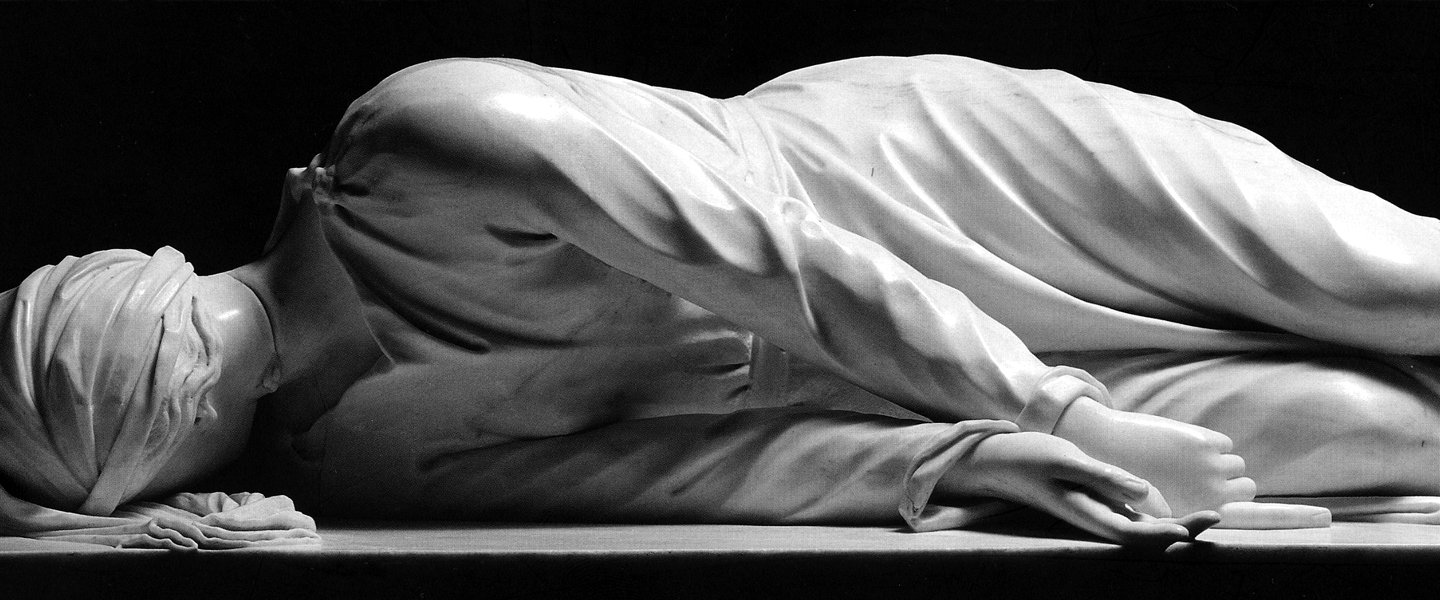
In 821 A.D. Pope Paschal I had Cecilia’s body removed from its burial place in the Catacomb of St. Callistus, where it was found incorrupt, and reinterred under the altar in the Basilica of St. Cecilia. Almost seven centuries later, in 1599, the titular bishop of the basilica, wishing to enlarge and decorate the structure, excavated beneath the altar and opened Cecilia’s coffin as well as her husband’s. All present were deeply moved when they saw Cecilia’s body, still perfectly incorrupt, lying on her right side as naturally as if she were asleep. The sculptor Stefano Maderno was commissioned to carve the saint in this position of her martyrdom.
To his glory, He who is glorified in his saints would not allow “His beloved to know decay” (Psalm 16)—a sign to all virgins consecrated to Christ, of their Spouse’s enduring love. Thus the charism bequeathed by this virgin martyr to St. Cecilia Congregation is much more profound than the pleasant influence of music. Cecilia’s music is the eternal heavenly call, which sounds in the soul despite the noise and pressures of the world, inspiring the bride to an unshakeable vow of love even unto death.